Talaq: Divorce by Husband:
The word divorce comes from the Latin word divortium, which means separation. A person who is divorced is called a divorcee.
Under Muslim law, a marriage ends either by the death of a spouse or by divorce. Divorce may be initiated by the husband, known as Talaq, or by mutual agreement of both spouses, called Talaq-e-Mubarat.
In Islam, the husband has the right to pronounce Talaq verbally, which is valid under Sharia law. However, in Pakistan, a verbal divorce alone is not legally sufficient.
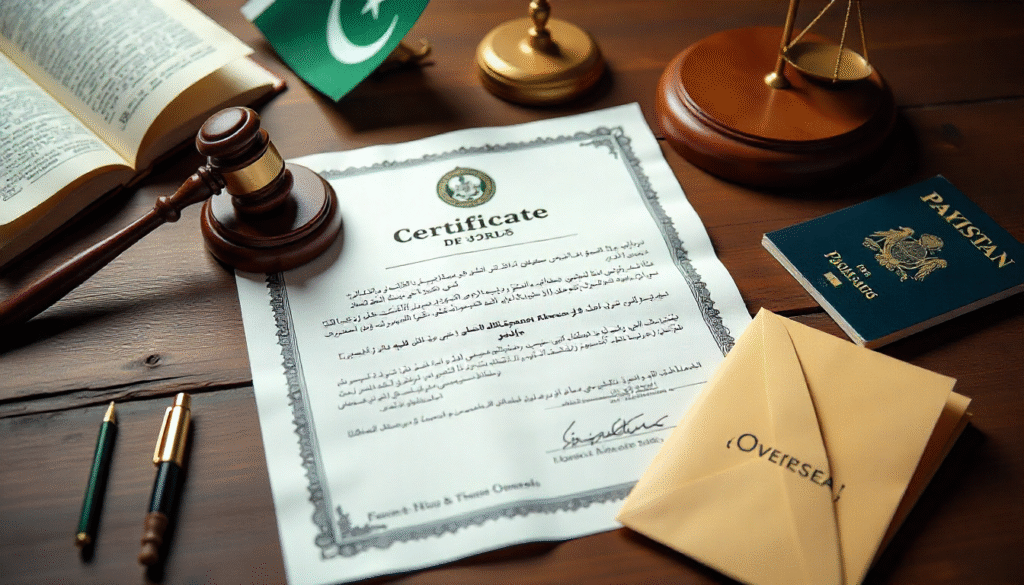
Pakistani law requires the Talaq Nama to be in written form (Urdu or English) and properly registered with the Union Council or Arbitration Council. This legal registration is mandatory for a valid divorce in Pakistan.
Islamic Divorce
Islamic law recognizes three main types of divorce. Each has a different process and level of acceptance:
1. Talaq-e-Ahsan:
This is the most preferred and approved form of divorce in Islam. It involves one pronouncement of Talaq, followed by a three-month Iddat period. During this time, reconciliation is possible if the couple resumes marital relations. This method allows time for reflection and reunion.
2. Talaq-e-Hasan
In this method, the husband pronounces Talaq three times, once in each menstrual cycle over a period of about three months. If reconciliation does not take place after the third pronouncement, the marriage is dissolved.
3. Talaq-al-Biddat (Triple Talaq)
This is an irrevocable form of divorce where the husband pronounces Talaq three times at once. Most Islamic scholars discourage this method because it does not allow time for reconciliation.
Iddat Period After Divorce
In Pakistan, the mandatory Iddat period after divorce is 90 days under state law. Islamic law also requires the completion of three menstrual cycles, which usually equals about 90 days.
The main purpose of observing Iddat is to confirm that the wife is not pregnant from the former husband and to ensure legal and religious clarity after divorce.
Other Modes of Dissolution of Marriage
Talaq-e-Tafweez (Delegated Divorce)
In this type, the husband gives the right of divorce to the wife through the Nikahnama. The wife may use this right according to agreed terms.
Khula
Khula is a divorce initiated by the wife through the court. The wife usually returns her dower (mahr) to seek separation.
Talaq-e-Mubarat (Mutual Divorce)
This is a divorce by mutual consent where both husband and wife agree to end the marriage. All marital rights end after dissolution.
Divorce Law in Pakistan
Divorce in Pakistan is governed by the Muslim Family Laws Ordinance, 1961. The law provides a legal procedure for divorce but does not require any specific words or format for pronouncing it.
Under Pakistani law, a husband does not need to give a reason to divorce his wife. There is also no legal requirement for the divorce to be pronounced in the wife’s presence.
Courts have confirmed that Islam requires only a clear intention by the husband to end the marriage. No specific words are necessary, and the divorce does not need to be directly addressed to the wife.
Difference Between Divorce and Khula
Khula
- Initiated by the wife
- Filed through the Family Court
- Court approval is required
- After court decision, Union Council issues divorce certificate
- Based on wife’s unwillingness to continue marriage
- Requires court proceedings and evidence
- Wife usually returns dower (mahr)
- Mediation and reconciliation are encouraged by court
- Considered a last option after reconciliation fails
- Involves court and lawyer fees
Divorce
- Initiated by the husband
- Pronounced directly by the husband
- Court is not required unless there is a dispute
- Union Council issues divorce certificate after talaq notice
- Based on husband’s decision, no reason required
- Requires only husband’s pronouncement
- Husband must pay dower (mahr) and dues
- No mandatory mediation required
- Can be issued at husband’s discretion
- Usually low cost (stamp paper and publication)
Law for Divorce in Pakistan
Pakistani courts have clearly explained the difference between Khula and Divorce (Talaq) in several judgments.
Khula is the wife’s legal right to seek dissolution of marriage through the court by returning consideration (usually mahr) when she cannot continue the marriage. A judge’s decision is required to grant Khula.
Divorce (Talaq) is the husband’s right to end the marriage without court involvement. The main difference is that Khula is initiated by the wife through the court, while Talaq is exercised by the husband directly.
Essential Conditions for a Valid Divorce
Capacity
The husband must be a sane Muslim adult. A minor or a person of unsound mind cannot pronounce Talaq, except during a lucid interval.
Free Consent
Form of Talaq
Talaq may be given orally or in writing. No specific words are required as long as the intention to end the marriage is clear. Under Shia law, Talaq must be pronounced orally in the presence of two witnesses.
Clear Intention
Divorce Procedure in Pakistan
Divorce in Pakistan is governed by Section 7 of the Muslim Family Laws Ordinance 1961. The law provides a clear process to follow, ensuring the divorce is legally valid.
The following steps explain how to file a divorce in Pakistan and complete all legal requirements.
TalaqNama / Divorce Notice
When a husband decides to divorce, he must submit a written TalaqNama in Urdu or English to the Chairman of the Union Council immediately after pronouncing Talaq. A copy must also be given to the wife. The notice should be printed on stamp paper of the required value.
Contents of Divorce Deed (TalaqNama)
A TalaqNama or divorce deed should include:
- The type of divorce being issued
- Personal details of both spouses
- Marriage details, including date and dower (Haq Mehr), whether immediate (Muajjal) or deferred (Ghair Muajjal)
- Any terms agreed between the spouse
- Reasons for divorce (optional)
Documents Required for Divorce in Pakistan
To file a divorce in Pakistan, the following documents are needed:
- Valid ID: CNIC for Pakistani nationals; Passport or foreign ID for overseas Pakistanis or foreigners
- Nikah Nama: Proof of marriage, such as Nikahnama or Marriage Registration Certificate
- Divorce Deed: Properly written TalaqNama on stamp paper
Serving Divorce Papers and Penalties
Serving Divorce Papers:
Divorce papers must be sent to the wife via a recognized courier.
Copies must also be sent to the Union Council near her residence or where the Nikah was registered.
If the wife’s location is unknown:
Send to the address in the NikahNama or her last known address.
Alternatively, serve through her father, mother, or adult sibling.
If all else fails, the notice may be published in a newspaper with Union Council approval.
Penalties for Non-Compliance:
- Failure to submit the notice may lead to up to one year imprisonment, a fine up to PKR 5,000, or both.
Effectiveness of Talaq:
Talaq becomes effective 90 days after the notice is delivered to the Chairman, allowing time for reconciliation.
This 90-day period also serves as the Iddat period after divorce.
Role of the Union Council
After receiving the Talaq notice, the Union Council Chairman must, within 30 days:
Form an Arbitration Council
Help the couple reconcile and avoid divorce if possible
Take all necessary steps to encourage reconciliation
NADRA Divorce Registration Certificate
If reconciliation fails, the Union Council documents the attempts and, after the third notice, issues a divorce registration certificate through NADRA.
If the wife is unavailable, the certificate is issued to the husband; the wife can collect it later.
The Union Council ensures a fair divorce process and provides both parties time to reconcile.
Triple Divorce Law in Pakistan
Instant triple Talaq (all three divorces at once) is viewed differently across Islamic schools of thought:
Fiqah Jaffaria, Maliki, Shafi’i: Do not recognize it as valid.
Hanbali: May consider it valid if marriage is consummated and specific conditions are met.
Connection to Pakistani Law
The Muslim Family Law Ordinance, 1961 (Section 7(3)) regulates Talaq to prevent instant divorce.
Divorce becomes effective 90 days after notice to the Union Council.
This period allows revocation or reconciliation and aligns with Islamic principles.
Why Instant Talaq is Restricted
Islam discourages hasty divorce.
Instant Talaq can leave women socially and financially vulnerable.
Section 7(3) ensures spouses have time to reconsider before divorce takes effect, protecting rights and promoting fairness.
If you want, I can also combine all the divorce sections we’ve rewritten into a single concise, website-ready page for Moiz Law Firm. This would make it client-friendly and easy to navigate.
Other Modes of Marriage Dissolution (Section 8, Muslim Family Law Ordinance 1961)
Section 8 of the Ordinance allows marriage to be dissolved other than by Talaq, including cases where the wife has been delegated the right to divorce or where both parties mutually agree. The rules of Section 7 apply as needed.
Divorce Initiated by the Wife (Khula)
A wife can file for Khula in the Family Court to legally end her marriage. This empowers her to seek justice and dissolve the marriage when she cannot continue.
Mutual Divorce
A mutual divorce occurs when both husband and wife agree to end the marriage. It is a simple, amicable process and often the quickest way to resolve marital issues. Expert legal guidance can help ensure a smooth procedure.
Delegated Right of Divorce
Clause 18 of the NikahNama allows the husband to delegate his right of divorce to the wife. Once granted, this right cannot be revoked unilaterally. This delegation gives the wife legal authority to initiate divorce without waiting for the husband to act.
If you want, I can now combine all the divorce sections we’ve rewritten into one complete, website-ready Divorce/Family Law page for Moiz Law Firm. It would be easy to read, SEO-friendly, and client-focused.
Divorce During Pregnancy in Pakistan
If the wife is pregnant when Talaq is pronounced, the divorce will not take effect until 90 days have passed or the pregnancy ends, whichever comes later.
I can also combine this with the other divorce sections into a complete, website-ready Divorce Law page for Moiz Law Firm, making it easy for clients to read and understand.
Remarrying the Same Husband After Divorce
A wife can reconcile with her husband within 90 days of Talaq, before the NADRA divorce certificate is issued. Even after the certificate, they can remarry without Halala, as long as the divorce has not occurred three times.
If a husband pronounces Talaq for the third and final time, the divorce becomes irrevocable. In this case, Halala is required: the wife must marry another man, and only if that marriage ends naturally—through divorce or the death of the second husband—can she remarry her first husband.
For Khula, the divorce is considered a single irrevocable separation, and both spouses can remarry each other after the wife’s iddat without the need for Halala.
Christian Divorce Law in Pakistan
Divorce for Christian marriages is governed by The Divorce Act of 1869. The law sets strict rules for different types of marital separation, requiring clear evidence to support claims.
1. Dissolution of Marriage (Sections 10-17)
A spouse can apply for dissolution when the marriage is irreparably broken.
Husband’s grounds: Primarily adultery by the wife
Wife’s grounds: Adultery, bigamy, incest, cruelty
Strong evidence is required, such as proof of adultery or the involvement of co-respondents.
2. Nullity of Marriage (Sections 18-21)
This applies to legally invalid marriages. Either spouse can file a petition if the marriage was invalid from the start.
Grounds include:
Spouse was impotent at the time of marriage
Prior existing marriage
Marriage within prohibited degrees
Mental incapacity at the time of marriage
3. Judicial Separation (Sections 22-26)
Spouses can live separately without dissolving the marriage.
Grounds include:
Adultery
Cruelty
Desertion
Reversal of Judicial Separation (Section 26)
If the decree was made in the absence of a spouse, it may be reversed if the absent spouse proves the decision was based on false or incomplete facts. Rights and obligations during the separation period remain unaffected.
Hindu Divorce Law in Pakistan
Hindu marriages and divorces in Pakistan are governed by the Hindu Marriage Act, 2017. The Act outlines the procedure and grounds for ending a Hindu marriage.
Modes of Divorce
1. Termination by Court
Either spouse may file for divorce based on fault by the other spouse.
Grounds for wives include:
Husband fails to provide maintenance for at least two years
Husband sentenced to imprisonment for four years or more
Marriage solemnized before the wife turned 18 (repudiation allowed before 18)
Grounds for either spouse include:
Cruelty or desertion by the other spouse
Conversion to another religion
Incurable disease or HIV/AIDS
Renunciation of worldly life for religious purposes
No cohabitation after one year of judicial separation
2. Divorce by Mutual Consent
Both spouses may file jointly if:
They have lived separately for at least one year
They agree that they cannot live together
The court grants divorce six months after filing the petition.
3. Judicial Separation
Allows the couple to live separately without fully dissolving the marriage.
Provides time for possible reconciliation
Legally acknowledges separation while keeping the marriage intact
4. Remarriage After Divorce
After the divorce decree and the expiry or dismissal of any appeal:
Either party may remarry the same spouse
A waiting period of six months is required before remarriage
Conclusion
Whether you are seeking Talaq, Khula, mutual divorce, or divorce under Islamic, Christian, or Hindu law, each type of marriage dissolution has its own grounds and legal procedures. Following the proper process is essential to ensure a smooth and legally valid divorce.
At Moiz Law Firm, our experienced divorce lawyers can guide you through the process efficiently and provide expert legal support for a smooth divorce in Pakistan.
Disclaimer: This article is provided for public awareness. It is not legal advice. For personalized guidance, contact Moiz Law Firm.