
Online Khula
Online Khula
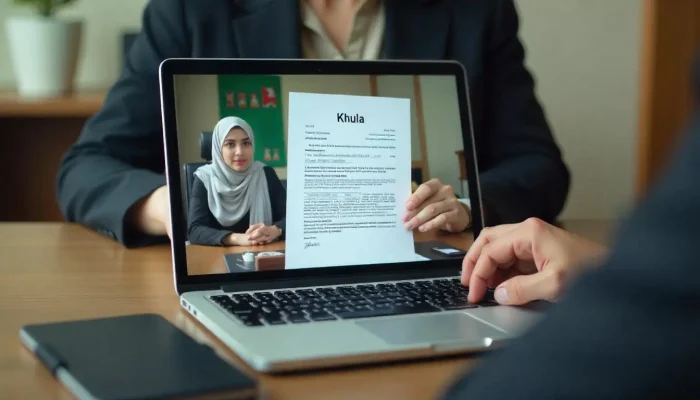
This guide provides clear and practical information on how overseas Pakistani and foreign wives married to Pakistani husbands can file for Khula online. It explains the procedure and requirements to help you navigate the process smoothly from abroad.
Instant Consultation
What Is Khula?
Khula is a legal process that allows Muslim women to end their marriage under certain conditions, usually when the wife cannot continue living with her husband within the limits set by Islam.
The term “Khula” means to lay down. Legally, it refers to the husband giving up his rights and authority over his wife. In a Khula, the wife may provide compensation to the husband in exchange for the divorce, which makes it different from Mubarat (mutual divorce).
The number of Khula cases in Pakistan is increasing. Every woman should understand her rights before starting the process. This guide explains how an overseas wife can file and complete Khula online in Pakistan, receive a Family Court decree, and obtain a Khula certificate from the Union Council. Moiz Law Firm is dedicated to helping women understand their rights and make informed decisions about ending their marriages.
Khula in Islam
The concept of Khula is based on the Holy Quran. Islam allows a woman to seek separation if she cannot continue the marriage within the limits set by Allah.
According to the Quran, if both husband and wife fear that they cannot fulfill their marital duties properly, the wife may return her dower (Haq Mehr) or agreed compensation to the husband in order to obtain divorce. This form of separation is known as Khula.
Allah has clearly permitted this process as a lawful way to end a marriage with dignity and fairness. Khula ensures that a woman is not forced to remain in a marriage that causes hardship or injustice.
This principle is explained in Surah Al-Baqarah (2:229), which sets the Islamic foundation for Khula.
Khula under Mahomedan Law (D.F. Mulla)
According to Mahomedan Law by D.F. Mulla, Khula is a form of divorce initiated by the wife. In Khula, the wife agrees to give compensation to the husband in exchange for being released from the marriage.
The compensation may include waiving the Haq Mehr (dower) or any other mutually agreed financial arrangement. Once the husband agrees to the Khula, the divorce becomes final and irrevocable.
Even if the wife does not pay the agreed compensation, the Khula remains valid. However, the husband has the legal right to recover the agreed amount through court proceedings.
Khula Under Pakistani Law
Definition
Under Pakistani law, Khula is a legal right granted exclusively to women to seek dissolution of marriage through the court. According to a Supreme Court judgment (2024 PLD 645 SC), a woman who obtains Khula may remarry the same husband without the requirement of Halala.
Legal Recognition
Khula is fully recognized under Pakistani law and is governed by the following laws:
Muslim Family Laws Ordinance, 1961
West Pakistan Family Courts Act, 1964
Dissolution of Muslim Marriages Act, 1939
West Pakistan Family Courts Rules, 1965
These laws provide the legal framework for filing and deciding Khula cases in Pakistan.
Khula Laws in Pakistan
Under Pakistani law, a wife has the legal right to seek dissolution of marriage through Khula. Section 8 of the Muslim Family Laws Ordinance, 1961 recognizes Khula as a lawful method of ending a marriage. A Khula case is filed before the Family Court under the West Pakistan Family Courts Act, 1964, which has the authority to decide such matters
Conditions to File a Khula Case
Free Will:
The wife must clearly express her own decision to seek Khula. Her consent must be free from pressure, force, or influence from family members or others.
Unwillingness to Live with Husband:
If a wife decides that she cannot continue living with her husband, the court may grant Khula even if the husband is not at fault.
No Need to Give Reasons:
A wife is not required to prove hatred or provide detailed reasons. It is enough for her to state that she does not wish to live with her husband. She cannot be forced to remain in the marriage against her will.
Summary
The Khula process in Pakistan is straightforward. If a wife decides she no longer wants to continue the marriage, the law protects her right to seek separation through the Family Court without strict legal requirements.
Online Khula for Overseas Pakistani Wives or Foreign Nationals
If you are an overseas Pakistani wife or a foreign national married to a Pakistani husband, and your Nikah is registered in Pakistan, you can apply for Khula online without traveling to Pakistan.
How Online Khula Works
Pakistan’s legal system allows wives living abroad to initiate Khula remotely. You can appoint a representative in Pakistan through a Special Power of Attorney (SPA), who will manage the Khula proceedings on your behalf. Additionally, the E-Court System enables you to give your statement via video call, eliminating the need to appear in court physically.
Khula Through Special Power of Attorney
A Special Power of Attorney allows you to authorize a family member, friend, or lawyer to act for you in Pakistan. Under the Attorney Act 1882 and Contract Act 1872, your representative can file and manage the Khula case entirely online, while you remain abroad.
Online Khula Using E-Court System
The E-Court System allows the wife to provide her statement or evidence through video call or other electronic means accepted by the court. This system is available in almost all districts of Pakistan and is especially useful for overseas wives or those who cannot travel to Pakistan.
Conditions to Initiate a Khula Case
Free Will: The wife must genuinely want Khula without coercion or undue influence.
Determined not to live with the husband: Khula can be filed when the wife no longer wishes to live with the husband, even if he has done nothing wrong.
No need to justify hatred or aversion: The wife does not have to provide detailed reasons. A simple statement expressing her unwillingness to live with her husband is sufficient. (Ref: 2003 MLD 1120, 2014 YLR 1743)
In short, the Khula process is straightforward and clear. If a wife decides not to continue the marriage, she cannot be forced to stay, and the dissolution does not require complicated reasoning.
Grounds for Dissolution of Marriage by Wife
Under the Dissolution of Muslim Marriages Act, 1939, a Muslim woman in Pakistan has the legal right to seek dissolution of marriage on specific grounds. The law protects a woman’s right to end a marriage when continuation becomes difficult or unjust.
A wife may file for dissolution of marriage on the following grounds:
Husband Missing: If the husband has been missing and his whereabouts are unknown for four years.
Failure to Provide Maintenance: If the husband has not provided financial support for two years.
Second Marriage Without Permission: If the husband contracts another marriage without following the Muslim Family Laws Ordinance, 1961.
Imprisonment: If the husband has been sentenced to seven years or more in prison.
Failure to Perform Marital Duties: If the husband fails to fulfill marital obligations for three years without valid reason.
Impotence: If the husband was impotent at the time of marriage and continues to be so.
Mental Illness or Serious Disease: If the husband suffers from mental illness for two years or has leprosy or a serious contagious disease.
Underage Marriage: If the wife was married before the age of 16, she may repudiate the marriage before turning 18, provided the marriage was not consummated.
False Allegations (Lian): If the husband falsely accuses the wife of adultery.
Cruelty: Including physical or mental abuse, immoral conduct, forcing immoral acts, taking her property, denying legal rights, restricting religious practice, or unfair treatment among multiple wives.
Any Other Valid Ground: Any other reason recognized under Muslim law.
Documents Required to File a Khula Case
To file a Khula case in Pakistan, the following documents are required:
Copy of CNIC or Passport
Copy of Nikahnama
Copy of Marriage Registration Certificate
What If the Wife Does Not Have a Nikahnama or Marriage Certificate?
A wife can still file a Khula case even if she does not have the original Nikahnama or Marriage Registration Certificate. A copy of these documents is usually sufficient.
If no written proof of marriage is available, the wife may file an affidavit on oath stating that the Nikahnama is not available.
In such cases, the court may also require the statements of two Nikah witnesses to confirm that the marriage took place.
Khula During Pregnancy
A wife can file a Khula case during pregnancy by applying to the Family Court. However, the Khula does not take legal effect during pregnancy.
The divorce becomes final and legally effective after the child is born.
What If the Husband Does Not Agree to Khula?
A husband’s consent is not required for Khula. Even if he disagrees, the wife can still obtain a divorce through the Family Court.
If the husband contests the case, the Court may first try to reconcile the couple. However, if the wife remains firm in her decision, the Court will grant Khula and dissolve the marriage.
Khula Procedure under the West Pakistan Family Court Act, 1964
The main steps in a Khula case include:
Filing the case – Institution of suit (Section 7)
Notifying the husband – Intimation to the defendant (Section 8)
Written statement – May include claims for restitution (Section 9)
Pre-trial proceedings – Immediate decree for dissolution if applicable (Section 10)
Recording evidence – Presentation of proofs by both parties (Section 11)
Trial conclusion – Judgment and decree issued (Section 12)
Intimation to Arbitration Council – After decree for dissolution (Section 21B)
This process ensures the wife’s right to Khula is protected while following all legal formalities.
Khula Process in Pakistan
1. Filing the Khula Case (Section 7)
The wife files a suit for dissolution of marriage in the Family Court. The case may also include claims related to:
Dowry (Haq Mehr)
Maintenance
Personal property and wife’s belongings
Child custody and guardianship
Visitation rights of parents
2. Intimation to Husband (Section 8)
The Court sends a Khula notice to the husband, requiring him to appear in person or through counsel and submit a written statement.
3. Non-Appearance of Husband
If the husband does not appear, the Court proceeds ex parte (without him), records evidence, and can pass a decree dissolving the marriage in favor of the wife.
4. Written Statement by Husband (Section 9)
If the husband appears, he must submit a written statement and list of witnesses. He may claim restitution of conjugal rights, which can affect maintenance and other claims.
5. Pre-Trial Hearing (Section 10)
The Court schedules a pre-trial hearing to:
Examine the case
Attempt reconciliation between the spouses
If Reconciliation Fails:
The Court passes a Khula decree
The wife may be asked to return up to 50% of deferred dower or 25% of prompt dower, depending on the case
If Reconciliation Succeeds:
The Court passes a decree based on the compromise or settlement reached by the couple
6. Recording of Evidence (Section 11)
The Court records statements of the wife, husband, and any witnesses.
7. Judgment and Decree (Section 12)
After reviewing evidence, the Court makes a final attempt at reconciliation. If unsuccessful, a decree is issued.
In exparte cases, the decree is sent to the husband’s address within 3 days at the wife’s cost
8. Notification to Union Council (Section 21B)
The Family Court sends an attested copy of the Khula decree to the Chairman or Secretary of the relevant Union Council within three days to complete legal formalities.
Khula Certificate from Union Council Online
After the Family Court issues a Khula decree, it is sent to the Union Council/Arbitration Council. The Council follows these steps:
Notice for Reconciliation: Three notices are sent to both parties to give them a chance to reconcile.
90-Day Period: If reconciliation fails within 90 days, the Council makes one final effort to resolve the matter.
Effectiveness Certificate: Once reconciliation attempts are complete, the Union Council issues a Khula Certificate through NADRA.
This certificate confirms that the Khula is legally effective. After obtaining it, both parties are free to remarry if they wish, by presenting the certificate.
Iddat After Khula
After a Khula, a wife must observe a mandatory waiting period called Iddat.
The duration of Iddat is 90 days.
The purpose of Iddat is to ensure there is no pregnancy from the former husband.
During this period, the wife completes three menstrual cycles, which usually conclude within 90 days.
After the Iddat period ends, the wife is free to remarry.
Return of Dower (Haq Meher) After Khula
If a wife seeks Khula, she may need to:
Give up up to 50% of unpaid dower (Ghair Muajjal Haq Meher)
Return up to 25% of prompt dower (Muajjal Haq Meher) already received
This is according to Section 10(5) of the Family Courts Act, 1964.
However, if the marriage is dissolved under Section 2 of the Dissolution of Muslim Marriages Act, 1939, the wife does not have to return any dower and can claim her full Haq Meher.
Appeal Against Khula and Other Modes of Divorce
Appeal Against Khula
A Khula decree cannot be appealed.
Exception: If the marriage is dissolved due to cruelty under Section 2(vii)(a) of the Dissolution of Muslim Marriages Act, 1939—such as abuse, immoral conduct, or denial of legal rights—the decree can be appealed.
Other Modes of Divorce
Talaq-i-Tafweez (Delegated Divorce): The husband gives the wife the right to divorce in the Nikahnama, which she can exercise if needed.
Mubarat (Mutual Divorce): Both husband and wife agree to part ways, ending all marital rights and obligations.
Divorce by Husband (Talaq): The husband can unilaterally divorce his wife without her consent.
Difference Between Khula and Mubarat
Khula
- Initiated by the wife
- Filed through the family court
- Husband’s consent not required
- Wife may have to waive or return dower
- Needs judicial approval and evidence
- Court encourages mediation and amicable settlement
- Cost may include legal fees and court charges
Mubarat (Talaq-e-Mubarat)
- Done with mutual consent of both husband and wife
- No court intervention needed
- Requires consent of both spouses
- No financial settlement required
- Based on mutual agreement only
- Usually straightforward without mandatory mediation
- Cost may include only stamp paper fee
Difference Between Divorce and Khula
Khula
- Initiated by the wife
- Filed through the Family Court
- Court approval is required
- After court decision, Union Council issues divorce certificate
- Based on wife’s unwillingness to continue marriage
- Requires court proceedings and evidence
- Wife usually returns dower (mahr)
- Mediation and reconciliation are encouraged by court
- Considered a last option after reconciliation fails
- Involves court and lawyer fees
Divorce
- Initiated by the husband
- Pronounced directly by the husband
- Court is not required unless there is a dispute
- Union Council issues divorce certificate after talaq notice
- Based on husband’s decision, no reason required
- Requires only husband’s pronouncement
- Husband must pay dower (mahr) and dues
- No mandatory mediation required
- Can be issued at husband’s discretion
- Usually low cost (stamp paper and publication)
Conclusion
A wife can initiate the Khula process without her husband’s consent. She files a suit in the Family Court, which may attempt reconciliation. If reconciliation fails, the court issues a decree of dissolution of marriage, which is then sent to the Union Council. The Khula certificate is usually issued after about 90 days, which also counts as the Iddat period.
Khula is a woman’s right to free herself from an unhappy or oppressive marriage, breaking outdated customs and practices.
Moiz Law Firm, a trusted law firm with experienced lawyers, provides this information for public awareness on our website, moizlawfirm.com. This content is for informational purposes only and is not legal advice.
For personalized guidance on obtaining Khula in Pakistan or any legal assistance, contact our expert family lawyers. We offer tailored solutions to help you every step of the way.
Our Process
We carefully review your legal issue and plan the best strategy based on your situation and legal requirements.
Our lawyers analyze all facts, documents, and legal options to build a strong and effective case.
Other Practice Area
- Divorce Lawyer
- Child Custody
- Khula Lawyer
- Khula for Overseas
- Online Nikah
- Court Marriage
- Child Maintenance
- Guardianship
- Wife Maintenance
- Divorce for Overseas
- Visitation Rights
- Jactitation of Marriage
- Company Registration
- Partnership Firm Registration
- Sole Proprietorship Registration
- NTN Registration
- Income Tax Return Filing
Let Us Help You !
If you are facing a legal issue, Moiz Law Firm is here to support you. Contact us today to receive clear legal advice and professional assistance tailored to your situation.