
Court Marriage
Court Marriage in Pakistan: Procedures and Legal Requirements
Many people in Pakistan have misconceptions about court marriages, often thinking they are conducted in a courtroom or before a judge. This is not the case.
A court marriage is simply a marriage registered under Pakistani law, ensuring legal recognition. This section explains how it differs from a traditional marriage, the procedures involved, legal requirements, potential issues, and why it is referred to as a “court marriage.”
Instant Consultation
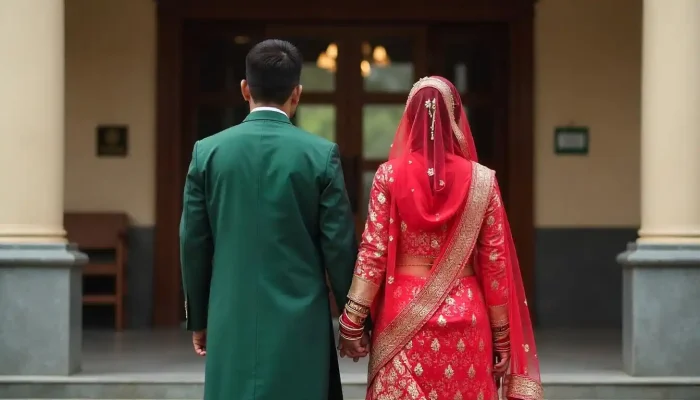
Understanding Court Marriage in Pakistan
The Constitution of Pakistan, 1973, guarantees every individual the right to marry. Couples who are sane and of legal age cannot be stopped from marrying, even if their parents or families oppose it.
In such cases, couples often seek the assistance of a lawyer. The lawyer arranges a Nikah Khawan (Molvi or Qari) to perform the Nikah. After the ceremony, the marriage is registered with the Union Council and NADRA, and a NADRA Marriage Registration Certificate is issued.
No court is involved unless there is a threat from family members. If protection is needed, the court may get involved to safeguard the couple’s rights. In such situations, the bride may give a statement in court confirming her consent, which helps prevent frivolous litigation against the groom.
This is why such marriages are often called “court marriages” in Pakistan—though, in reality, they are regular Nikahs performed in a non-traditional way with the court ensuring legal protection.
Islamic Perspective on Court Marriage
Islam does not prohibit an adult man and woman from marrying each other. In fact, Islam encourages Nikah and strictly forbids unlawful relationships like Zina.
A court marriage is permissible in Islam as long as all conditions are met:
Both bride and groom have reached the age of majority
They do not fall within prohibited degrees of relationship
All other Islamic marriage requirements are fulfilled
When these conditions are satisfied, a court marriage is valid and acceptable under Islamic law.
Legality of Court Marriage in Islam
A marriage that fulfills the requirements of Islamic law is legally protected in Pakistan. The Constitution of Pakistan, 1973 (Article 35) guarantees protection of marriage, family, and the right to freely contract a marriage under Islamic law.
Islamic Law Perspective:
Marriage is considered a civil contract between a man and a woman. A formal deed is not required to prove a valid marriage (2004 PCRLJ 622).
A valid marriage can also be presumed if the couple mutually acknowledges each other as husband and wife (2021 YLRN 105). This mutual recognition is sufficient to establish the marriage under Shariah.
Age Requirements for Court Marriage in Pakistan
The minimum legal age for a court marriage in Pakistan is 18 years for both the bride and groom. Both parties must have attained the age of majority to legally contract the marriage.
Documents Required for Court Marriage in Pakistan
To register a court marriage in Pakistan, the following documents are required:
CNIC of both bride and groom
B-Form of bride and groom (if CNIC is not available) to verify age
For a second marriage:
- Bride: Divorce certificate or death certificate of previous husband
- Groom: Divorce certificate, death certificate of previous wife, or a permission letter from the existing wife
Court Marriage Procedure in Pakistan
The steps for conducting a court marriage in Pakistan are as follows:
Nikah Ceremony: A Qari performs the Shariah Nikah in front of witnesses, including the agreement on Haq Mehr.
Marriage Registration: The marriage is registered with the Union Council and NADRA.
Marriage Certificate: NADRA issues the official marriage registration certificate.
Protection from Harassment: If families oppose the marriage, a court case can be filed for protection.
Bride’s Statement in Court: The bride may give a statement confirming she married with her free consent to protect the groom from any legal issues.
Verification: The authenticity of the marriage can be verified online via the Union Council or NADRA systems.
Basic Requirements for a Valid Court Marriage
A valid court marriage (Nikah) requires:
Proposal and Acceptance by the bride and groom
Witnesses: Either two male witnesses or one male and two female witnesses
Legal Reference: 2020 CLC 549 confirms that these three elements—proposal, acceptance, and presence of witnesses—are essential for a valid Islamic marriage.
Nikah Without Wali (Guardian)
In Pakistan, a woman over 18 years old can perform her Nikah without the consent or presence of a Wali (guardian), whether it is a Shariah Nikah or a registered marriage.
Traditionally, a Wali—usually the bride’s father or a male Mahram relative—ensures the bride’s consent and acts as her guardian. However, legally, a woman of majority age can marry independently.
Legal Reference: In 2020 CLC 549, the court held that a well-educated woman over 27 years old is fully competent to enter into Nikah according to her own wishes, without any third-party intervention or Wali.
Online Marriage in Pakistan
Online marriage is valid under Islamic law and is also recognized in Pakistan.
To be legally recognized, an online marriage must be registered with the Union Council and NADRA. The couple can perform the marriage in the presence of witnesses, which makes it valid, and they become husband and wife.
To legally prove the marriage, a Nikah Nama registered with the Union Council or a NADRA Marriage Registration Certificate is required. In some cases, the marriage can also be verified through witness statements or video recordings of the online ceremony.
Court Marriage Certificate in Pakistan
In Pakistan, the official documents proving a marriage are:
Marriage Certificate from the Union Council
Marriage Registration Certificate (MRC) issued by NADRA
There is no separate certificate specifically for court marriage.
However, if the bride has recorded a statement in court confirming that she married with her free consent, an attested copy of this statement can be attached to the Nikah Nama for future reference.
Court Marriage Fees and Costs in Pakistan
The costs for a court marriage in Pakistan include:
Union Council Registration & NADRA MRC: Fees are fixed according to the provincial policies.
Qari (Nikah Khawan) Fee: Paid as per mutual agreement with the couple.
Lawyer’s Fee: Varies depending on the complexity of the case and the lawyer chosen.
For sensitive cases like court marriages, it is recommended to hire an experienced lawyer in Pakistan.
You can contact us or fill out the form to get an instant consultation regarding court marriage procedures and fees.
Our Process
We carefully review your legal issue and plan the best strategy based on your situation and legal requirements.
Our lawyers analyze all facts, documents, and legal options to build a strong and effective case.
Other Practice Area
- Divorce Lawyer
- Child Custody
- Khula Lawyer
- Khula for Overseas
- Online Nikah
- Court Marriage
- Child Maintenance
- Guardianship
- Wife Maintenance
- Divorce for Overseas
- Visitation Rights
- Jactitation of Marriage
- Company Registration
- Partnership Firm Registration
- Sole Proprietorship Registration
- NTN Registration
- Income Tax Return Filing
Let Us Help You !
If you are facing a legal issue, Moiz Law Firm is here to support you. Contact us today to receive clear legal advice and professional assistance tailored to your situation.